
.
-
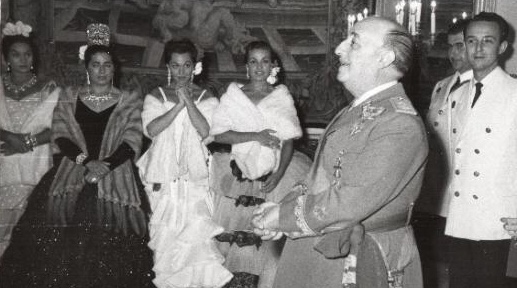
Nacionalflamenquismo: State Sponsorship and the Construction of Authenticity under the Franco Regime
Following the Spanish Civil War, General Francisco Franco established a fascist, authoritarian dictatorship that ruled Spain from 1939 until his death in 1975. This regime deliberately co-opted flamenco, transforming a historically marginalised practice into a tool for state-building. The phenomenon of nacionalflamenquismo functioned as a coercive strategy designed to appropriate this cultural form. By claiming…
-
Demófilo and the Folkloric Turn: The 1881 Colección as a Foundational Text
When Antonio Machado y Álvarez published his Colección de cantes flamencos in Seville in 1881 under the pseudonym “Demófilo”, he did not merely assemble an anthology of Andalusian lyric verse; he staged an intervention. Appearing precisely at the moment when the café cantante was consolidating the commercial professionalisation of flamenco, the Colección sought to rescue…
-

The Economics of Exile: Patronage, Migration, and the Itinerant Flamenco Artist during the Crisis of the State, 1923–1939
The collapse of the Restoration regime and the subsequent dictatorship of Miguel Primo de Rivera (1923–1930) fractured the traditional geographic enclaves of Andalusia, driving performers into the expanding metropolitan networks of Madrid, Barcelona, and international circuit destinations. Canonical historiography frequently treats the Golden Age as a stable, regionally bounded ecosystem of the café cantante, yet…
-
The Archival Illusion: How the Golden Age Disciplined Flamenco
The concept of the Edad de oro (Golden Age) remains one of the most resilient structuring fictions in flamenco historiography. Conventional narratives routinely map this epoch onto the final decades of the nineteenth century, demarcating a luminous window in which vocal virtuosity, stylistic variety, and uncorrupted expressive intensity purportedly reached their apex. Yet treating the…
-
The Phonograph and the Archive: Early Sound Recording and the Standardisation of Cante
The early interactions of early sound recording and flamenco history demand a methodologically eclectic framework capable of critiquing long entrenched polarised positions. To frame the introduction of phonograph cylinders and 78 rpm shellac discs from the 1890s onwards simply as an unmediated preservation of an authentic tradition or as a purely destructive commercial corruption is…
-
Beyond the “New”: Re-evaluating the Canon of Contemporary Flamenco Studies
The conceptualisation of a “new” flamencology, once a radical disruption to the mid-twentieth-century orthocanon established by Anselmo González Climent and his contemporaries, has itself matured into an established academic orthodoxy. When modern critical methodologies first challenged essentialist narratives of pure cante jondo, immutable Gitano-Andalusian dichotomies, and romanticised regional isolation, the movement earned its distinction by…
-
Flamenco’s Many Scholarships
The history of flamencology (a term not used until the 1950s) remains haunted by a persistent teleological fantasy: the notion that the study of flamenco has steadily progressed from the naive, essentialist myth-making of mid-twentieth-century enthusiasts towards the objective, enlightened maturity of the modern university. This narrative routinely casts founding figures such as Anselmo González…
-
Boris Asaf’ev and Flamenco: the Soviet connection
In mainstream musicological scholarship outside Eastern Europe, Boris Asaf’ev (1884-1949) occupies a distinctly marginalised position. Frequently categorised merely as an institutional functionary of Soviet musicology or as the composer of state-sanctioned ballets such as The Fountain of Bakhchisarai, his theoretical output has rarely been acknowledged. This omission is further compounded by a simple historical reality: Asaf’ev…
-
Why Analysing Flamenco is Difficult
Within the discipline of musicology, the formal analysis of flamenco presents a unique set of challenges that test the limits of conventional music-theoretical frameworks. Whilst Western art music relies heavily on a written score to anchor and stabilise pitch and temporal parameters prior to execution, flamenco operates from within an oral paradigm of transmission. When…
-
Disciplining the cante: From café cantante to Tablao
The performance spaces of flamenco have always been deeply intertwined with the material realities of Spanish politics and capital. The transition from the late nineteenth-century café cantante to the mid-twentieth-century tablao represents a deliberate restructuring of cultural production. By examining the political economy of the tablao, we uncover the mechanisms through which the regime of General Francisco Franco instrumentalised an…